Research
I am interested in dynamical systems and control. Specifically, I study general nonlinear systems (without assuming additional structure) in a systematic way. The Koopman operator theory is central to my research, as it enables the systematic study of complex systems through algebraic structures that are more suitable for scalable algorithmic procedures compared to geometric viewpoints.
My work is structured around three key areas:
- 1Rigorous Mathematical Foundations: Developing the underlying theoretical structures.
- 2Efficient Data-Driven Algorithms: Creating algorithms with guaranteed convergence and accuracy.
- 3Real-Time Applications: Applying these algorithms for practical prediction and control tasks.
Research Themes
Koopman Operator Theory
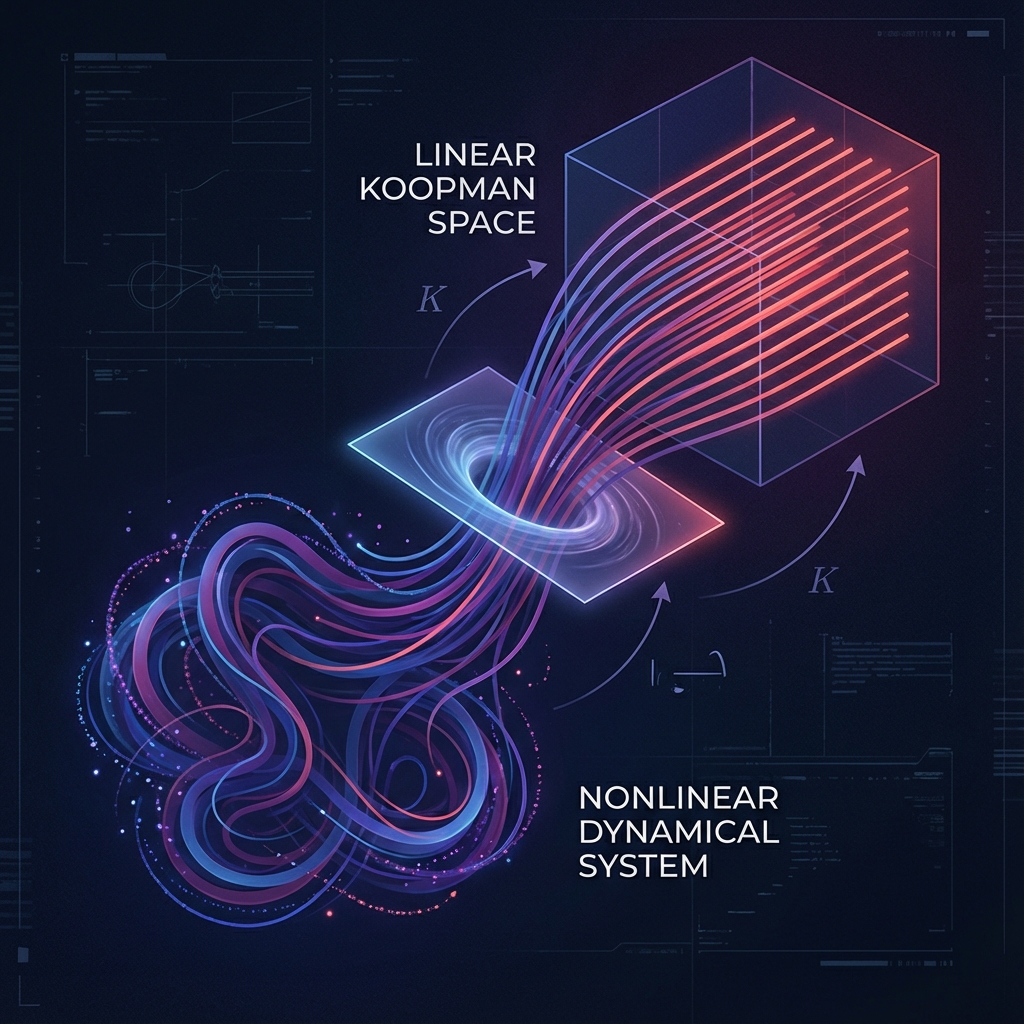
Linear representations of nonlinear dynamics
The Koopman operator represents a dynamical system via a linear operator acting on a vector space of functions. This enables one to utilize regular algebraic structures to study complex nonlinear systems. Based on these algebraic structures, we have established theoretical guarantees (in the form of necessary and sufficient conditions) for accurately identifying Koopman eigenfunctions, eigenvalues, and invariant subspaces. The Symmetric Subspace Decomposition (SSD) algorithm provably identifies the maximal Koopman-invariant subspace and all eigenfunctions in the span of a given dictionary. We have also introduced the notion of invariance proximity, an objective accuracy measure that provides tight upper bounds on prediction error.
Rigorous Data-Driven Control
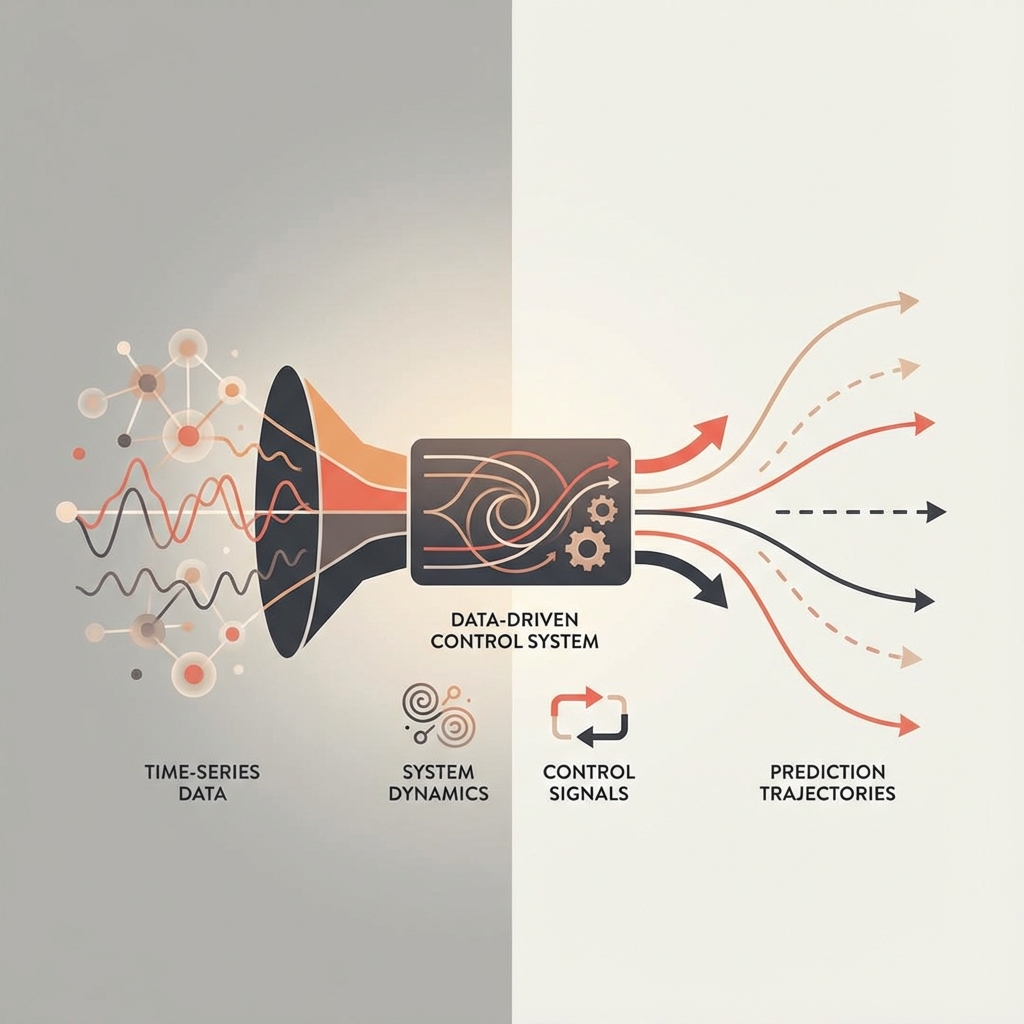
Formal extension of Koopman operator theory to control systems
Extending Koopman operator theory to control systems requires addressing the fundamental difference between 'input' and 'state'. We developed the Koopman Control Family (KCF), a comprehensive mathematical framework that fully encapsulates the behavior of general (not necessarily control-affine) nonlinear control systems. This framework leads to universal finite-dimensional forms termed 'input-state separable' models, which encompass commonly used linear, bilinear, and switched linear models as special cases. Our recent work establishes equivalence between KCF and other Koopman extensions for control, providing a unified theoretical foundation. The KCF framework naturally lends itself to rigorous data-driven modeling and robust learning.

Scalable Data-Driven Modeling and Prediction
Streaming data sets, parallel computing, and identification with tunable accuracy
We have developed a suite of algorithms addressing computational challenges in Koopman-based modeling. The Streaming SSD (SSSD) algorithm enables real-time computation on embedded systems by processing data incrementally with fixed memory. The Parallel SSD (P-SSD) algorithm achieves linear speedup with the number of processors and is robust against packet drops and communication failures. The Tunable SSD (T-SSD) algorithm allows users to balance model accuracy and expressiveness through a single parameter, generalizing both exact SSD and the widely-used EDMD method.
Real-Time Algorithms for Robotics
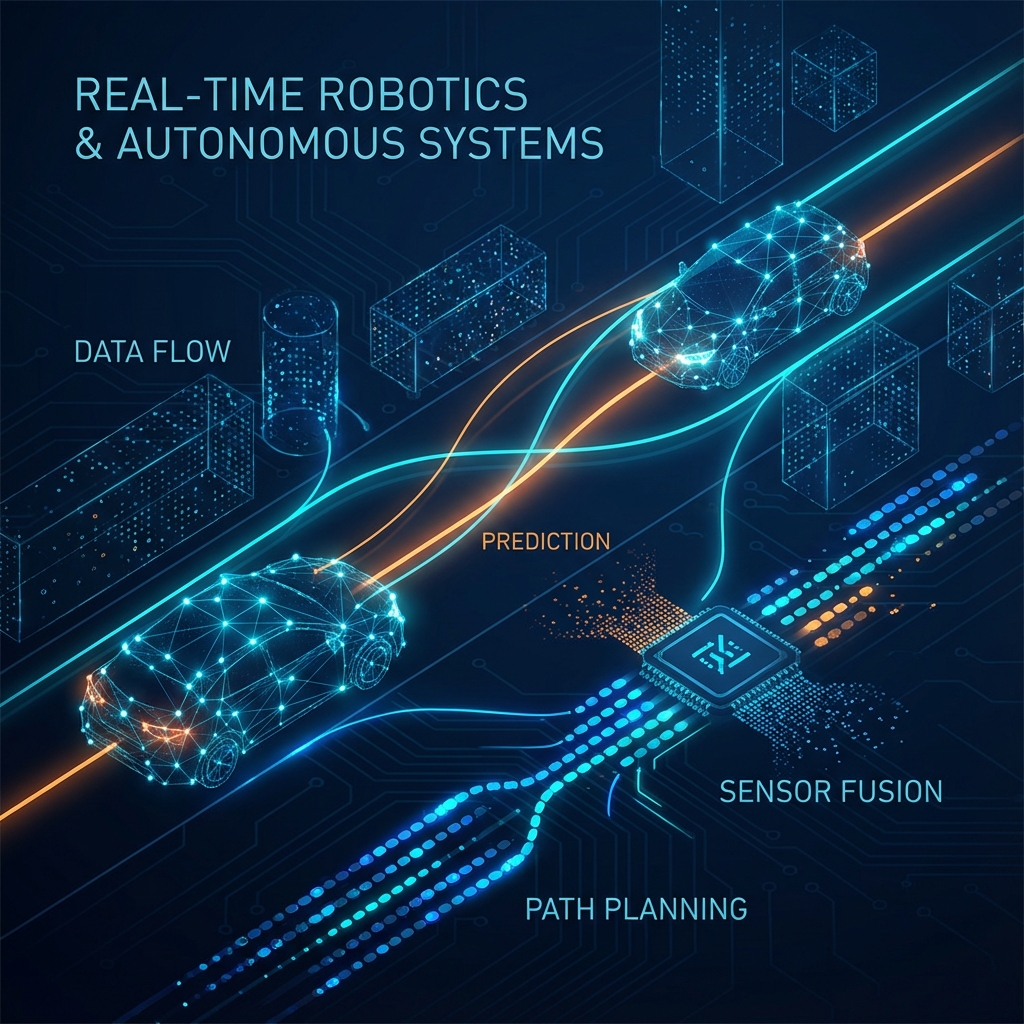
Fast adaptive methods for autonomous systems
Koopman operator methods offer unique advantages for robotics: they enable linear computations for nonlinear prediction, support incremental online adaptation as new data arrives, and are computationally efficient enough for real-time execution on embedded systems. These properties make them ideal for path planning and control in complex environments, handling noisy sensor data through robust estimation techniques, and adapting to changing dynamics without expensive retraining—critical capabilities for autonomous robots, self-driving vehicles, and systems operating in unstructured environments.
Awards
IEEE Control Systems Letters Outstanding Paper Award
IEEE Control Systems Society
“Temporal forward-backward consistency, not residual error, measures the prediction accuracy of extended dynamic mode decomposition”Robert Skelton Systems and Control Dissertation Award
University of California San Diego
“Data-Driven System Analysis Using the Koopman Operator: Eigenfunctions, Invariant Subspaces, and Accuracy Bounds”ACC Best Student Paper Award
American Control Conference
“Data-driven approximation of Koopman-invariant subspaces with tunable accuracy”